Ultimate Dive Travel Itineraries
9 Unforgettable Multi-Stop Adventures for Divers Around the World
From arctic plunges and wildlife encounters to coral reef hotspots and epic drift dives, these are our favorite dive itineraries for explorers who want to combine multiple bucket-list sites in a single trip.
No matter the experience level – novice to professional – divers often dream of that "one perfect dive trip." But the world's best diving rarely fits neatly into one location.
Fortunately, combining nearby or connected dive destinations into a single, seamless journey (while maximizing time and budgets) is now easier than ever. Some are road trips. Some are liveaboards. Some cross borders or even continents. But they all share one thing: they turn a week underwater into an adventure you'll remember for life.
Here are our favorite multi-stop dive itineraries – chosen by SCUBAPRO divers, tested in every ocean, and made for those who never stop exploring.
Region 1: North America & Caribbean
Warm waters, wild encounters, and surprising variety. All closer than you think.
For many divers, adventure doesn't have to mean far-flung. North America and the Caribbean hold some of the most varied diving on the planet - sharks and shipwrecks, coral reefs, freshwater caves, even kelp forests that feel like underwater cathedrals. The best part? You can string several of these experiences together with a few flights or a road trip. One week, three ecosystems, endless stories.
Here are three itineraries that prove you don't need a passport full of stamps to chase world-class dives.
Florida's Atlantic Coast + the Keys
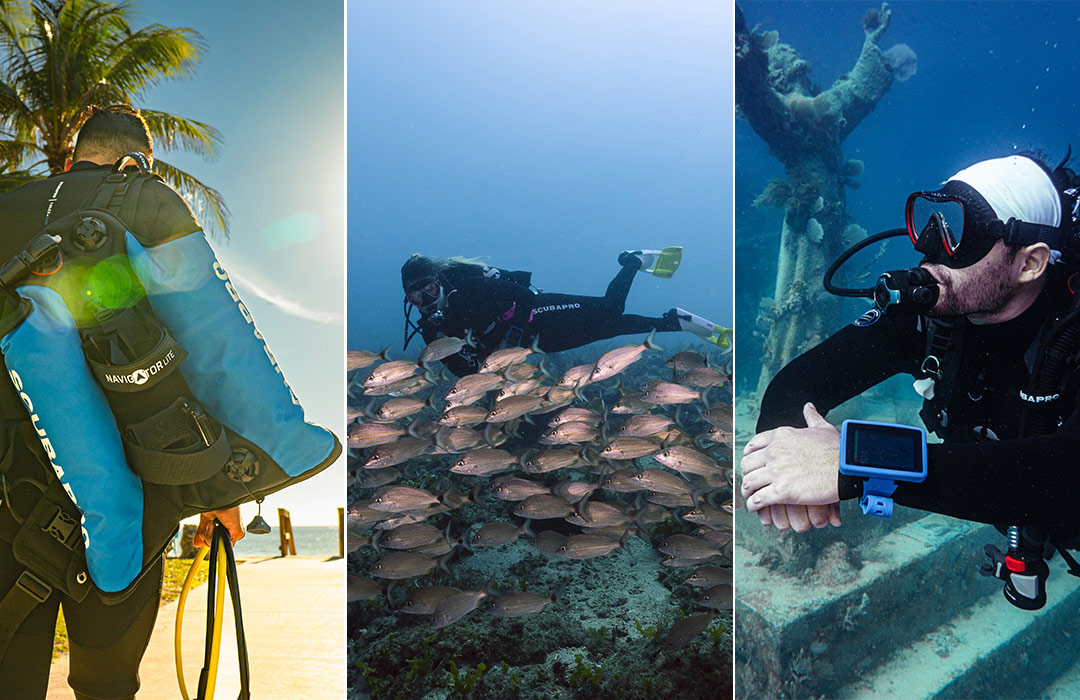
If you had to design a single U.S. road trip for divers, Florida would be it. Start up north in Jupiter or West Palm Beach, where the Gulf Stream hugs the coastline and brings in lemon, bull, and tiger sharks all winter. Drift diving here is pure adrenaline – clear water, steady current, and big animals right off the boat.
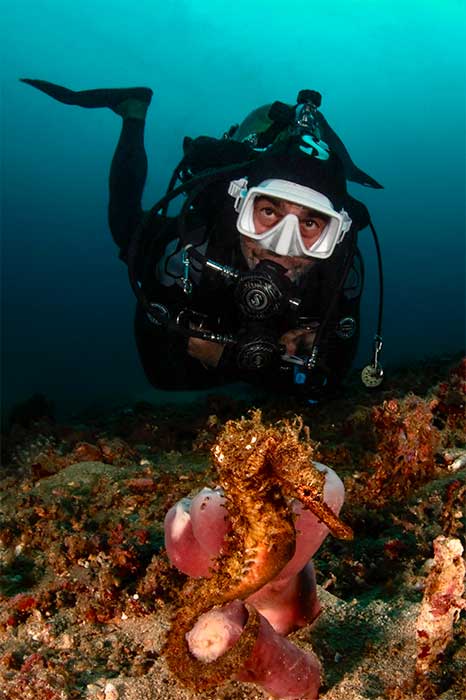
Head a little south to Blue Heron Bridge in Riviera Beach and the pace changes completely. This shallow, no-current zone is a macro paradise where you can spot seahorses, frogfish, and octopuses if you slow down long enough to look. From there, follow U.S. 1 over the Seven Mile Bridge and down into the Florida Keys. The Keys' iconic wrecks – Spiegel Grove, Vandenberg, and countless smaller ones – are massive, haunting, and teeming with life. When you're ready for something easy, drift over the shallow reefs of Molasses or French Reef and watch the sunlight dance through the coral.
The best part? You can dive all of this in a week. Rent a car, toss your gear in the trunk, and go. It's a sampler of Florida's entire marine world: big pelagics, tiny critters, and tropical reefs – and it's all within a few hours' drive.
Pro tip: Winter and early spring bring the best shark action up north. Time your Blue Heron dives for high slack tide to catch the clearest water.
Gear: When you're hitting multiple dive sites, having a BCD that adapts and travels with you is key. We recommend the Navigator Lite BCD as one of our fan-favorites for divers on the go.
Bonus/Alternate: If you have extra time in your itinerary, a great option for advanced divers is heading north instead of south, and exploring some of North Central Florida's best-kept secrets – the freshwater springs. Crystal clear water, epic cave systems, manatees, and so much more.
Cozumel + Cenotes (Yucatán Peninsula, Mexico)
Few places show off diving's range like Mexico's Yucatán peninsula. Begin in Cozumel, drifting along the walls of the Mesoamerican Barrier Reef – where highlights include turquoise water, effortless current, and sponges the size of cars. You'll see turtles, eagle rays, and maybe even a blacktip cruising the drop-off. It's warm, easy, and cinematic.
Then trade the Caribbean for the jungle. A quick ferry to Playa del Carmen and an hour's drive inland takes you to Tulum's legendary cenotes (sinkholes that open into vast limestone caverns). Dive Dos Ojos or The Pit, and you'll descend through beams of light that look like they were made for photographers. No current, just perfect visibility and total silence.
Doing both on one trip makes sense. Ocean drifts, freshwater caves... Two entirely different worlds, but only a few hours apart. The logistics couldn't be easier, and the contrast is unforgettable.
Pro tip: Spend 3-4 days in Cozumel and dive the ocean first, then travel to the cenotes second – equalizing can be smoother when you've already spent time in saltwater.
Gear: Make swapping the ocean for freshwater a breeze with our MK17 EVO 2/S620 Ti Dive Regulator System. Small, lightweight, and designed for effortless airflow in all underwater conditions.

Baja California + Sea of Cortez
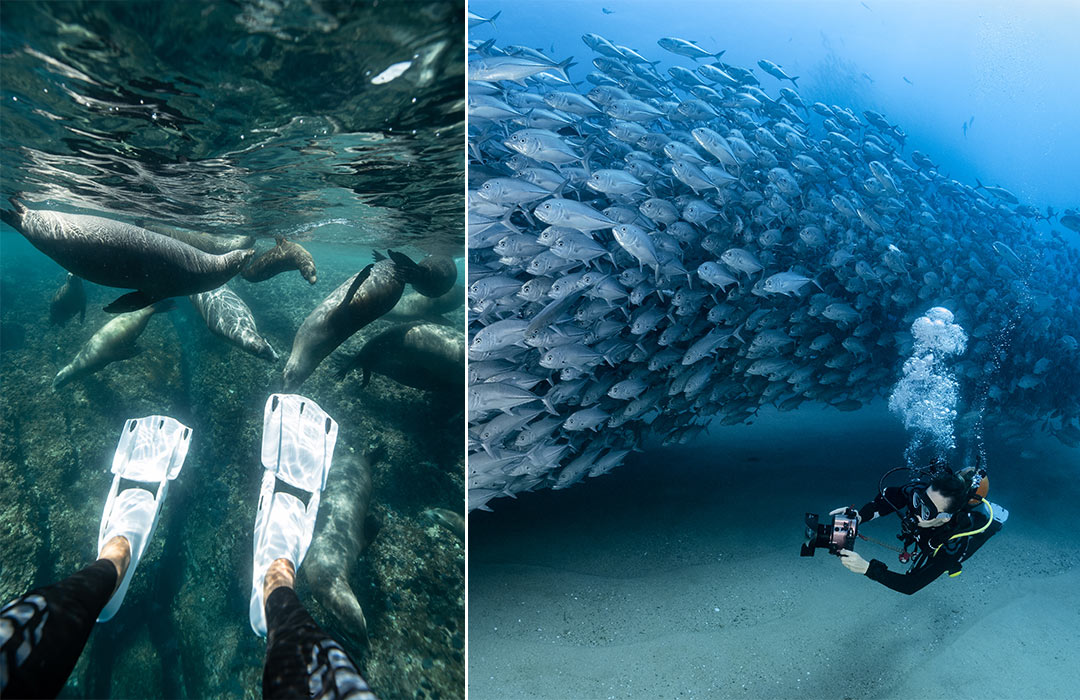
Baja is where the desert meets the ocean and everything comes to life. From La Paz, head to Los Islotes to dive with sea lions that treat bubbles (and sometimes, your fins) like toys. Between October and April, whale sharks cruise the bays and humpbacks breach offshore. A few hours away, the protected reefs of Cabo Pulmo National Park show what two decades of conservation can do: walls of jacks so dense they block the sun, bull sharks on patrol, and coral gardens in recovery.
If you've got time, add Magdalena Bay to the mix. It's one of the few places on Earth where you can dive or snorkel among schooling mobulas – sometimes thousands at once – and, if luck's on your side, orcas. It's remote, yes, but that's the point. Baja feels wild in the best way: raw, unfiltered, alive.
Pro tip: The best window for big life is late fall to early spring. Consider a liveaboard or guided expedition if you want to link La Paz, Cabo Pulmo, and Mag Bay in one go.
Gear: For technical divers, cenotes can be some of the most thrilling dive sites. Consider the G2 Wrist Dive Computer as you level-up your dive skills: intuitive and easy to use, this computer allows you to focus on the features around you while you descend through caverns and haloclines.
Also Worth the Trip:
- Alaska & British Columbia: Kelp forests, sea lions, and giant Pacific octopus – cold water, big rewards.
- The Bahamas: Island-hop for reef sharks, blue holes, and visibility so good it doesn't feel real.
From Cozumel's drifts to Jupiter's sharks to Baja's mobulas, North America delivers everything from tropical to temperate – proof that you don't have to fly halfway around the world for a true bucket-list dive. Sometimes the best adventures are just a few borders away.
2: EMEA (Europe, Middle East & Africa)
From desert seas to volcanic islands and glacial waters. This region has it all, and then some.
There's something magnetic about this region. It's not just the history or the landscapes, but the way every dive feels tied to place – coral rising from red desert, volcanic walls that drop into the Atlantic, or fissures carved between continents. The EMEA region offers wild variety for those willing to connect the dots. A single itinerary can take you from tropical reefs to ice-cold clarity, from soft corals to shipwrecks that bring you back in time.
The Red Sea Grand Circuit (Egypt)
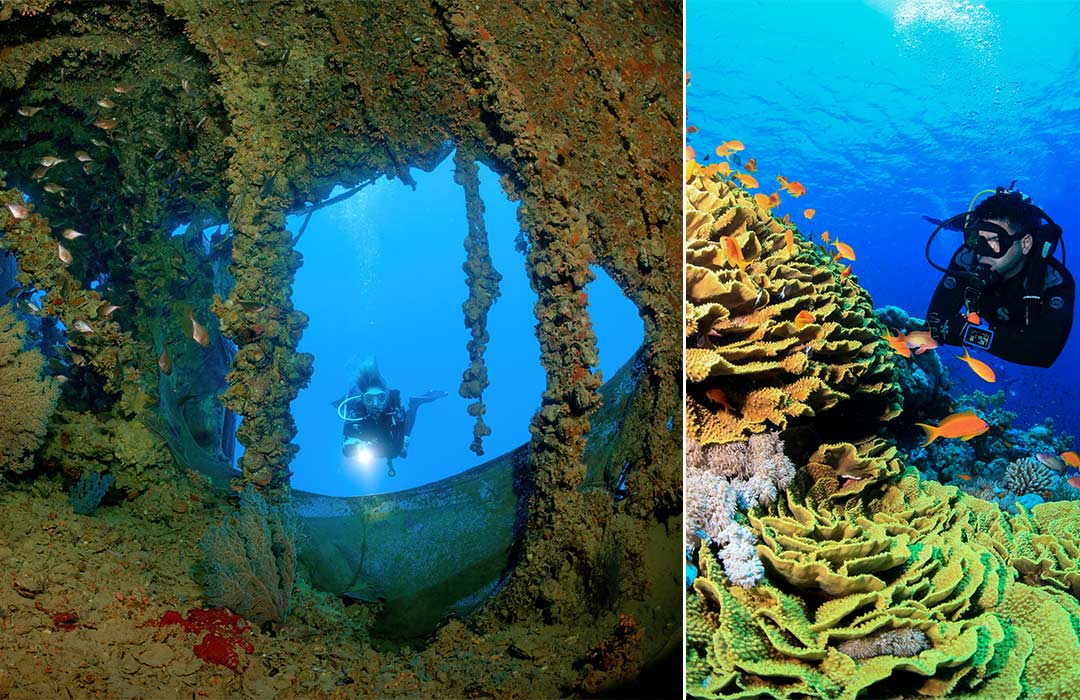
If you asked ten divers to name their dream trip, at least half would say the Red Sea. The color alone makes it special: corals that glow like neon signs, clouds of anthias against blue so deep it looks painted. But what makes this region truly bucket-list worthy is how easily its most famous sites link together.
Hop on a liveaboard from Hurghada or Marsa Alam and set a course for the big three: The Brothers, Daedalus, and Elphinstone. Each has its own personality – hammerheads and oceanic whitetips patrolling the blue at Brothers, endless soft corals draping Daedalus, and Elphinstone's dramatic wall dives where reef meets open sea. The liveaboard life only adds to the magic. Wake to a sunrise over glassy water, drink coffee as dolphins cruise past, and gear up for your first drop of the day.
There's nowhere else you can see so much variety in one trip – pristine reefs, wrecks, pelagics – all in a week. It's the definition of a classic for a reason.
Pro tip: The best visibility and calmest conditions usually land between March and June or September to November.
Gear: Reliable, dependable, fashionable. Our Seawing Nova Fins are a great addition to your Red Sea dive trip, giving you power, maneuverability, and ultimate comfort from the liveaboard to the reef.
Canary Islands + Madeira (Atlantic Islands)
The Atlantic can surprise you. Most people picture beaches and surf, but beneath the surface the Canary Islands and Madeira hold an entirely different world: imagine volcanic walls, underwater arches, and curious pelagic visitors drifting in from the deep.
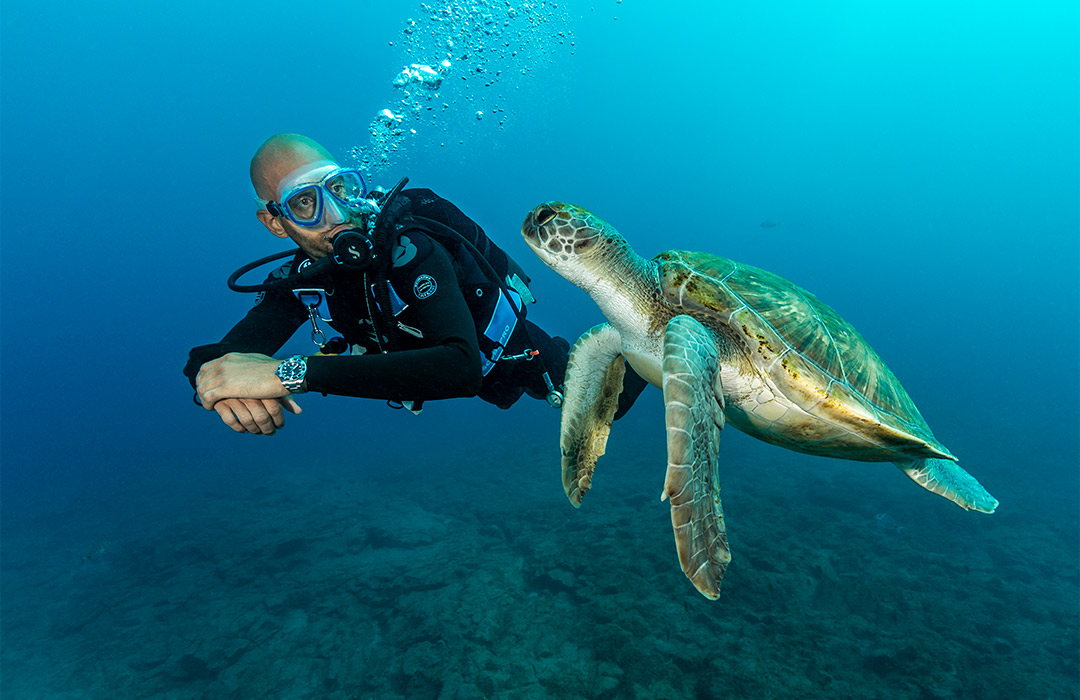
Start in the Canaries, either Tenerife or Lanzarote, where black lava reefs host rays, trumpetfish, and the occasional turtle. The visibility here rivals the tropics, and the underwater topography – caves, swim-throughs, sharp drop-offs – gives every dive a sense of exploration.
From there, catch a short flight to Madeira, Portugal's far-flung island chain, where the Atlantic becomes subtropical water. The dives here feel quieter and more intimate. Highlights include dusky groupers that follow you around, and schools of barracuda.
These two island groups share more than latitude: they sit in the same current, shaped by the same volcanic history. And because flights between them are quick and frequent, you can dive both in a single vacation without breaking the budget.
Pro tip: Summer to early fall brings the calmest seas and the widest variety of marine life.
Gear: For hopping flights, islands, and dives, the G3 Wrist Computer keeps you on time and in charge of your dive plan – above and beneath the waves.
Iceland + Scotland (North Atlantic Expedition)
Some trips are more than a holiday – they're a test of what kind of diver you are. Iceland and Scotland will remind you that cold water doesn't mean compromise; it means clarity, texture, and stories you can't find anywhere else.
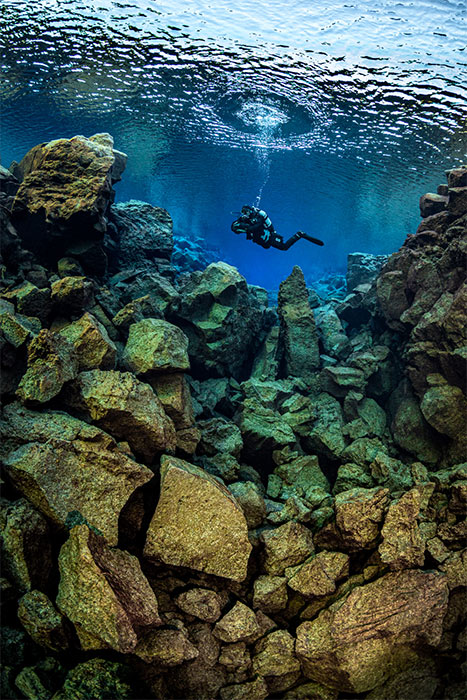
Start in Thingvellir National Park, where you'll dive the Silfra Fissure – a crack between the North American and Eurasian plates. The water is glacial and super clear, often with over 100 meters of visibility. It's a short, slow dive, but one that stays with you. From there, trade tectonics for history and fly to Scotland's Orkney Islands, home to Scapa Flow, one of the world's most iconic wreck diving destinations. The remnants of the German WWI fleet lie scattered across the seabed, monumental and eerie, with kelp wrapping their steel frames.
Both destinations demand drysuits and a little grit, but the payoff is immense – diving where few others will ever tread.
Pro tip: Plan dives between June and September when conditions are mildest and daylight stretches forever.
Gear: Even in the warmest months, the North Atlantic can be chilly. This trip is a great excuse to pack your drysuit, and your layers.
Also Worth the Trip:
- Italy + Greece + Malta: A Mediterranean circuit full of wrecks, caves, and warm-water reefs. Perfect for summer exploration.
- Portugal's Azores: Blue sharks, mobulas, and some of the most dynamic pelagic diving in the Atlantic.
The EMEA region has almost every kind of dive imaginable. The trick is linking them – one flight, one ferry, one liveaboard at a time – and suddenly you're not just crossing borders, you're crossing worlds.
3: Asia Pacific (APAC)
The world's most biodiverse waters... And the endless ways to explore them.
If diving had a capital, it would be somewhere in the Coral Triangle. Indonesia, the Philippines, Fiji, Vanuatu – these names are shorthand for wonder. Currents collide, reefs explode with life, and every island feels like the start of a new story. The best part is that many of these dream sites are closer together than they seem. With a little planning, you can link them into one journey – creating your own greatest hits tour of the Indo-Pacific.
Here are three itineraries that do exactly that.
Bali + Komodo (Indonesia)
Bali is the kind of place divers return to again and again – not just for the temples and the surf, but for the sheer diversity underwater. Start in the northeast around Tulamben, diving the USAT Liberty wreck at sunrise as the reef wakes up. Add a few days in Amed or Padangbai for gentle reef dives and a chance to spot ghost pipefish or pygmy seahorses. Then hop over to Nusa Penida, where manta rays sweep through Manta Point year-round and, if you're lucky, the legendary Mola mola drift through between July and October.
When you've had your fill, fly an hour east to Labuan Bajo, gateway to Komodo National Park. This is where the diving goes wild: fast currents, swirling schools of fish, reef sharks on patrol, and some of the healthiest coral gardens on Earth. It's also where you'll meet the Komodo dragon on land, just to remind you how prehistoric this corner of the planet really is.
Together, Bali and Komodo deliver a full dive spectrum. Calm to current, macro to megafauna, land to legend.
Pro tip: Give yourself at least ten days. Combine a few days of shore diving in Bali with a Komodo liveaboard for the ultimate contrast.
Gear: We'd recommend packing (or purchasing) your Seawing Supernovas, which are not only great for travel, but ideal in varying dive conditions – meaning you're ready for everything this dive trip has in store.
Philippines Explorer: Tubbataha + Dumaguete/Apo Island
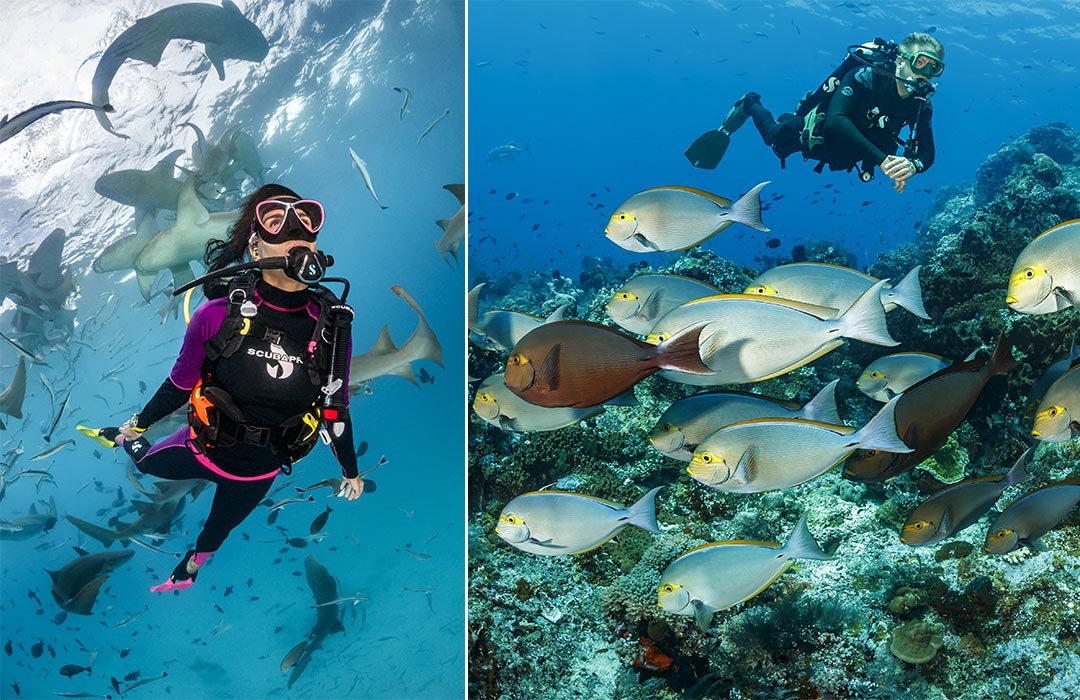
There's a reason the Philippines shows up on every diver's bucket list. It's as if someone designed the perfect dive playground and scattered it across 7,000 islands. For a true two-part adventure, start with Tubbataha Reefs Natural Park, a UNESCO site reachable only by liveaboard between March and June. The payoff is huge: pristine walls, hammerheads in the blue, turtles cruising over coral fields that are still untouched by tourism.
After a week offshore, head south to Dumaguete, a coastal town known for its calm waters and world-famous macro diving. The muck sites off Dauin are legendary, with highlights like flamboyant cuttlefish, frogfish, seahorses, and blue-ring octopus. Just a short boat ride away sits Apo Island, one of the country's earliest marine protected areas and a living proof of how communities can bring marine ecosystems back from collapse.
Think of this as the perfect pairing: deep wilderness and local stewardship, pelagics and macro, adventure and the feeling of being right at home.
Pro tip: Tubbataha is seasonal; plan for March to June. Dumaguete is diveable year-round, making it an ideal add-on before or after.
Gear: The last thing you want to worry about while diving is your air consumption. The Luna 2.0 Air Integrated Wrist Computer is a great option to help you maximize your bottom time from the depths to the shallows, in any conditions.
Fiji + Vanuatu (South Pacific Circuit)
If the Indo-Pacific is diving's heart, the South Pacific is its soul. Here, between the islands of Fiji and Vanuatu, you'll find warm hospitality above water and some of the most colorful, dramatic reefs anywhere on Earth below it.
Start in Fiji, known as the "Soft Coral Capital of the World." Around Bligh Water and the Somosomo Strait, the reefs pulse with color – purples, pinks, and reds that seem to glow from within. Add the chance to dive with bull sharks in Beqa Lagoon, and you've got one destination that hits both beauty and adrenaline.
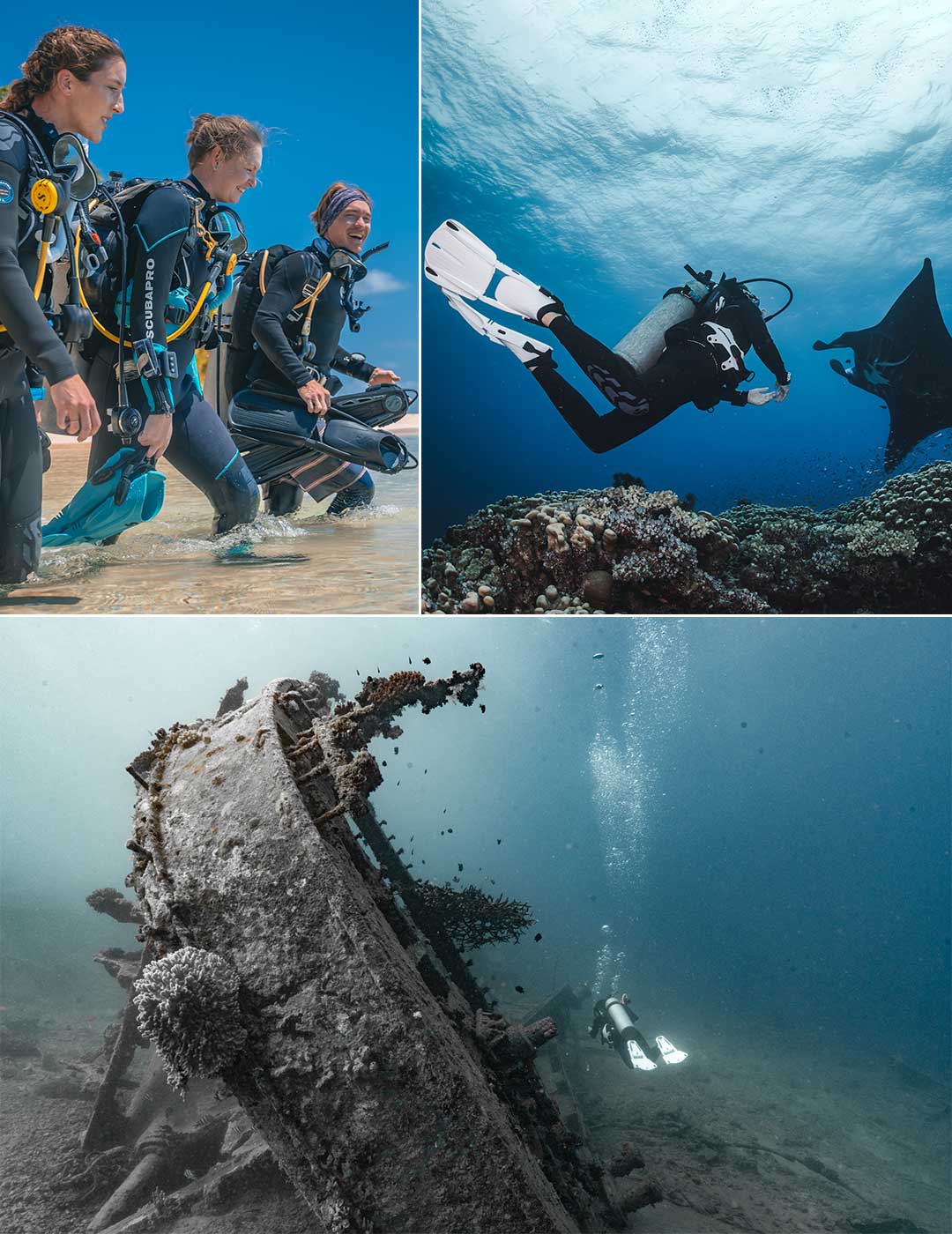
From there, it's an easy hop to Vanuatu, where the diving shifts from coral to history. The SS President Coolidge, a WWII wreck the size of a cruise ship, lies just off the shore of Espiritu Santo – one of the most accessible and awe-inspiring wrecks in the world. On other dives, volcanic formations and black sand create a moodier palette, with an undercurrent of geothermal energy that makes you feel the island's power.
Two nations and two very different worlds, all connected by ocean and the shared rhythm of island time.
Pro tip: Fiji's coral blooms strongest from June to October; Vanuatu is best from May to November. Both offer warm water year-round.
Gear: Traveling to some of the most remote dive sites on the planet means you need gear you can trust. Our Hydros Pro BCD is a team, Pro, and industry favorite. Compact, versatile, comfortable and convenient.
Also Worth the Trip:
- Raja Ampat + Banda Sea (Indonesia): Biodiversity capital of the world. Think endless reefs, mantas, and walls of fish.
- Papua New Guinea + Solomon Islands: True frontier diving, rich in culture, wrecks, and marine life.
Asia Pacific holds the blueprint for every kind of dive dream. It's the region that defines what "bucket list" really means – and reminds you that the ocean still has more to show.
–
Every trip changes you a little. Maybe it's the rush of a shark dive off Jupiter, the quiet of a dawn descent in the Red Sea, or the feeling of drifting through Komodo's currents with mantas overhead.
What makes these itineraries special isn't just how beautiful they are, but how easily one dive leads to the next. A week turns into a journey. You learn to pack light, to read the tides, to trust your instincts. You start chasing not just sites, but experiences – and the kind that stay with you long after your gear's rinsed and stowed.
Wherever you dive, your SCUBAPRO gear is meant to go the distance.
FAQs: Multi-Stop Bucket List Dive Itineraries
What is a multi-stop dive itinerary?
A multi-stop dive itinerary is a trip that links two or more dive destinations into a single journey - often combining reefs, wrecks, big-animal encounters, and unique ecosystems in one vacation.
Are these itineraries suitable for beginner divers?
Yes. Many routes (like Cozumel + Cenotes or Florida's Atlantic Coast + Keys) offer beginner-friendly sites. Others, like Komodo or Silfra, require more experience. Always match sites to your certification level and comfort.
How much time should I allocate for a multi-destination dive trip?
Most itineraries fit into 7-14 days, depending on travel time and how many regions you plan to combine.
When is the best time of year for bucket list dive trips?
Checking seasonal marine life patterns is key. It varies by region.
• Florida sharks: Winter - Spring
• Red Sea: March - June & Sept - Nov
• Baja megafauna: Oct - Apr
• Tubbataha: March - June
• Fiji soft corals: June - Oct
How do I handle gear when traveling between multiple dive locations?
Choose lightweight, travel-friendly gear (compact BCDs, modular fins, and reliable wrist computers). Many divers bring their own core gear and rent bulky items upon arrival.
Do I need special certifications for cenotes, wreck dives, or cold-water sites?
Some destinations recommend or require specialties:
• Cenotes: cavern or guided cavern experience
• Wreck penetrations: wreck or advanced certifications
• Dry-suit sites in Iceland/ Scotland: dry-suit certification
Are liveaboards necessary for these itineraries?
Not always. Some are perfect for road trips (Florida, Bali), while others are only accessible by liveaboard (Tubbataha, certain Red Sea routes).
How do I choose the right itinerary for my skill level?
Match your comfort with current, temperature, and depth. Warm-water reef combos suit beginners; strong-current sites like Komodo or Pelagic Red Sea routes are best for advanced divers.
Is it better to dive saltwater or freshwater first?
Most divers find it easier to start with saltwater dives, especially when transitioning to freshwater caves or cenotes afterward.
How do I protect camera gear and electronics when traveling between wet and dry environments?
Use dry bags, silica packs, and padded cases. Allow housings to fully dry before opening to avoid condensation or moisture damage.